Darky Gardiner
The Narrow Road to the Deep NorthDarky Gardiner is a young Tasmanian machine-gunner and sergeant whose wartime resourcefulness earns him the nickname the Black Prince. He moves through the novel as both a practical survivor and a source of fellowship: he finds food, steadies Dorrigo Evans under fire, and later stays beside Tiny Middleton when Tiny is wasting away. His repeated insistence that each throw of chance begins anew is tested by a world in which individual effort matters, but cannot command the outcome. His eventual drowning, recorded by Dorrigo as murder, turns that tension into one of the novel’s enduring losses.
Identity and Introduction
Darky first appears in the Syrian campaign, where he and six other Tasmanian machine-gunners are heading for the same destination as Dorrigo Evans. Their truck has broken down, so the men transfer their Vickers guns, tripods, and ammunition boxes onto spare mules and join Dorrigo’s party. The journey, expected to take two days, stretches across most of a week. Darky sometimes sings as they cross mountain tracks and damaged villages under artillery fire. The song does not remove the danger around them, but establishes his ability to continue in company with others through an increasingly exhausting passage.
At a village on the route, the contrast between Darky’s slight, skinny frame and his improbable possessions gives him a distinctive presence. His kitbag seems smaller than everyone else’s, yet yields food and cigarettes acquired through black-market trading, foraging, or theft. He has earned the name Black Prince through these small supplies and the ingenuity behind them. He shares Portuguese sardines with Dorrigo as French shells begin striking the village, and joins the men over coffee while they wait for orders. His practical generosity is part of his reputation: he does not merely manage to find things, but makes them available to the group.
Chance, Comradeship, and the Syrian Campaign
Darky’s view of chance becomes clearest over coffee in the village. He explains that even after the same result has occurred repeatedly, the next toss remains just as likely to produce it again. For him, every throw is still the first. The idea offers a way of facing uncertainty without pretending that past outcomes guarantee the next one. Dorrigo answers Darky’s wager that he will be dead by breakfast by betting that he will make it through the war; Jimmy Bigelow backs Dorrigo, calling Darky a survivor. Their exchange is teasing, but its stakes become immediate almost at once.
When a shell arrives, Darky leaps from his chair, grabs Dorrigo by the arm, and pulls him down. The blast destroys the striking blue, silver-fish chair in which Darky had been sitting, but Dorrigo survives. A second shell kills an Arab boy and Yabby Burrows. Rabbit Hendricks is left pushing his displaced dentures back into place. The rapid shift from joking predictions to irreversible loss shows both the force of Darky’s action and its limits: he can save the man beside him, but neither his instinct nor his philosophy can make the group safe. The chair’s little silver fish will recur later in a drawing that preserves an image of Darky even as the people around him disappear.
Camp Life and Responsibility for Others
In the prisoner camp, Darky’s fellowship is tested by deprivation, sickness, and the physical demands of forced labor. On a rain-soaked night, he returns to a shelter shared by twenty prisoners and finds Tiny Middleton occupying most of the space beside him. Darky is irritated by the cramped sleeping place and by Tiny’s illness, and initially resents having to lie so close to him. Their relationship is not founded on easy affection. It develops through the more difficult fact that Darky continues to care for Tiny despite discomfort and resentment.
Over the following weeks, he watches Tiny’s strength fade and recognizes that Tiny has lost the will to resist what is happening to him. Darky is revolted by Tiny’s decline and privately thinks that Tiny has given up. Yet he also understands that this judgment serves to reassure himself that survival depends on personal choice. He knows that he has no such control. He stays with Tiny anyway, because their survival belongs to the group rather than to any one man. The care he gives is therefore not a claim that courage or love can guarantee life; it is a refusal to treat another prisoner’s fate as someone else’s responsibility.
The camp’s scarcity also brings Darky into conflict with Rooster MacNeice. When Rooster discovers that the duck egg he had hidden is missing, he realizes Darky has taken it and used its shell to embarrass him in front of the others. Rooster’s anger is intensified by the public humiliation, and he comes to hate Darky with exceptional force. Later, Rooster sees Darky slip in the mud, spilling his rice porridge. He catches Darky’s distressed look, then turns away and eats his own ration. The episode sets Rooster’s hunger and resentment against the mutual obligations Darky embodies; even a small amount of food becomes a measure of what one prisoner will do for another.
Darky also serves as a gang leader. On a march through the jungle, he is in charge of sixty men despite having a severe fever. Prisoners pass tools along a human chain and help the weaker men and stretchers up a cliff, an effort that leaves Darky feeling somewhat stronger. He tries to reduce the guards’ interference, evade work quotas where possible, take opportunities to obtain useful supplies, and limit beatings. When Chum Fahey, not yet eighteen, is struggling with an ulcerated shin, Darky takes the heavy coil of wet rope from him and carries it himself. The gesture is one part of a larger effort to keep the men moving and alive.
Darky thinks of survival in immediate terms: life depends on getting the next footstep right, not on believing oneself destined to live. He watches the ground and places each step carefully, using rocks and fallen timber to avoid obstacles that would cost him more strength. Then his boot catches in a limestone cleft. The sole separates, his improvised repair fails, and he falls; he can no longer get up. The broken boot makes plain how narrow the margin is between continuing and collapse, even for a man who has worked so hard to preserve his strength.
Death and the Memories He Leaves
Darky’s beating remains difficult for those who remember it to interpret. In a later account, one witness cannot remember exactly how many Japanese engineers were present or whether they began by intending to hurt him. The beating comes to seem like tedious work to its perpetrators, the witness says, and that possibility frustrates any attempt to give the violence a comprehensible meaning. This uncertainty does not lessen the harm; instead, it shows how easily brutality can be treated as routine by those carrying it out, while surviving witnesses are left with the burden of trying to describe what happened.
The novel later reports Darky’s drowning through Bonox Baker. Dorrigo enters the death in his diary as murder, finding that even this word seems inadequate. The entry comes as Dorrigo prepares to meet a hundred men selected for a march, and he thinks of Darky, whose prolonged death he could only watch, alongside Jack Rainbow and the men he is about to send away. In this recollection, Darky’s death is not an isolated fact: it joins the accumulated consequences of choices made under coercion and the helplessness of witnessing suffering without being able to prevent it.
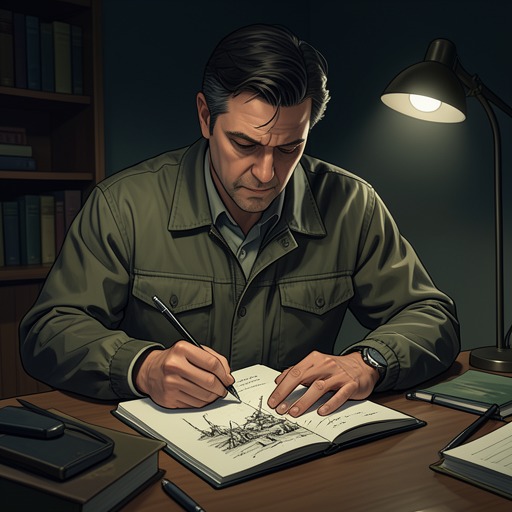
Darky persists in memory through both concrete objects and recurring phrases. Jimmy Bigelow later remembers the taste of the duck egg Darky gave him, together with hope and goodness; what lasts is not a complete record of the past, but a small act of sharing that can still be carried forward. Dorrigo, asked to write about the sketches of Guy Hendricks, finds that he has not thought of Darky for years until trying to write about his beating. He wants to recover Darky’s face, his singing, and his sly smile, yet can summon instead the damaged sky above the prisoners. Rabbit Hendricks’s illustration of Darky in the blue armchair, with silver fish seeming to swim through it, survives and is reproduced, while Yabby and Darky do not. The picture becomes a memorial whose persistence cannot repair the loss it represents.
Narrative Role and Significance
Darky’s principle that every throw begins anew gives memorable expression to life under conditions governed by chance. It can sustain a moment of hope, as when Dorrigo bets on Darky’s survival, but it does not promise that the next outcome will be kinder. The same campaign that lets Darky rescue Dorrigo kills Yabby and the Arab boy; the same attention to each step that helps Darky lead exhausted men cannot keep his boot from failing. The narrative gives his resourcefulness full weight without turning it into mastery over fate.
His clearest legacy is relational. Darky shares scarce food, intervenes to protect Dorrigo, helps organize men under forced labor, and stays beside Tiny even while resenting the demands of care. These actions connect survival to a community rather than to solitary strength. That conviction is not presented as a guarantee of rescue: Darky himself dies, and Dorrigo remains unable to save him. What endures instead is the obligation implied by their comradeship, preserved in a taste, a remembered song, a drawing, and the words that chance always begins again.